Start with the plant part
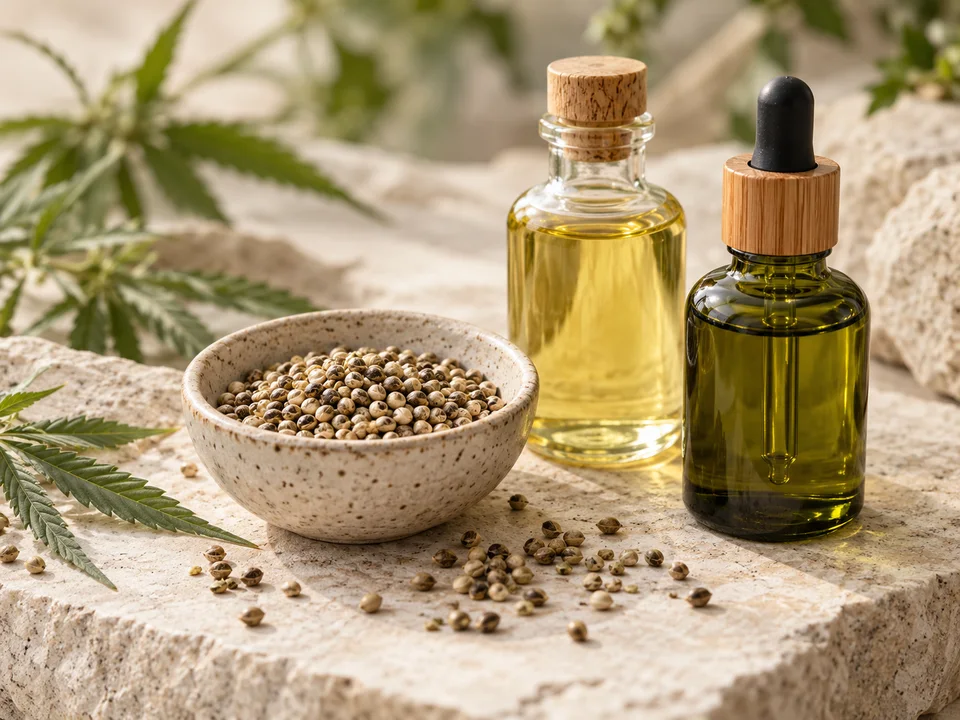
Hemp seed oil is made from the seeds. FDA explains that hemp seeds do not naturally contain THC or CBD, although trace amounts can be picked up during harvesting or processing. [1]
CBD oil describes a formulation
A CBD oil normally contains a CBD ingredient mixed with a carrier. Hemp seed oil may itself be used as that carrier. Seeing it in the ingredient list therefore does not tell you whether added CBD is present or how much there is.
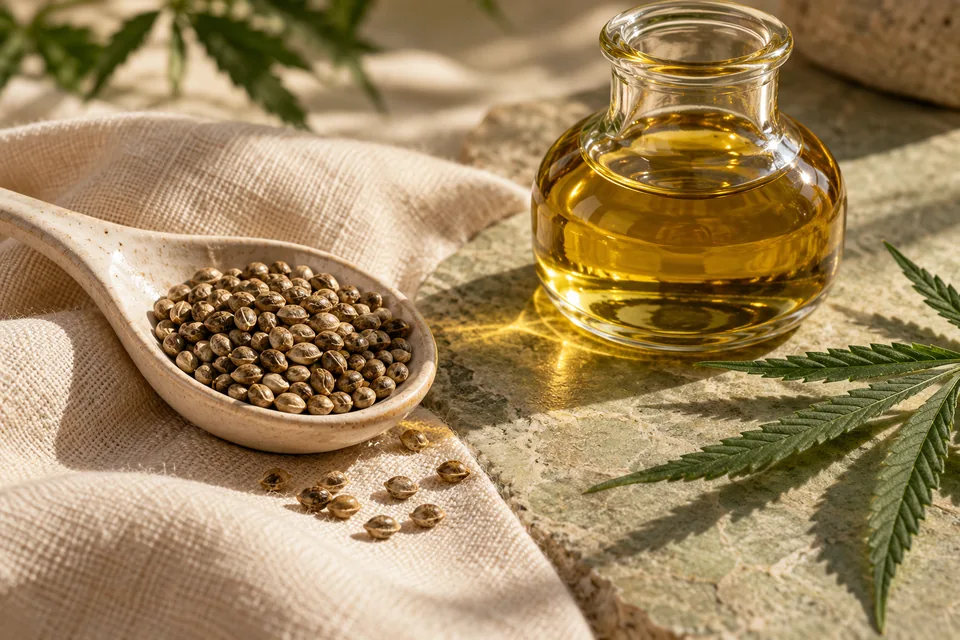
Hemp seed oil quantity does not establish a CBD amount. Look for an explicit CBD declaration and full ingredients.
Explore the data and checksIllustrative composition · AI-generatedWhat to look for on the label
Find a clearly stated CBD amount, package volume, ingredient list, and batch number. If the label only lists hemp seed oil in milligrams, do not reinterpret that as an equivalent amount of CBD.
Use a simple comparison
Put the two ingredient lists side by side. Highlight every reference to CBD, hemp extract, and seed oil. If the terms remain unclear, ask the seller what each number measures and request the matching report.
What does the milligram number actually name?
The first row documents a manufacturer’s published seed-oil label. The other rows are hypothetical examples, not products or recommendations.
| Label or example | What the number describes | CBD conclusion |
|---|---|---|
| Cannadoca seed-oil capsules: 500 mg per capsule | The manufacturer names hemp seed oil | Do not read this as 500 mg CBD |
| Hypothetical: 20 mg CBD with a seed-oil carrier | CBD is named separately from the carrier | 20 mg is the labelled CBD amount, not the carrier mass |
| Hypothetical: 500 mg hemp extract | The mass of an extract | CBD amount remains unstated without further detail |
| Hypothetical: hemp leaf image with no CBD figure | An illustration and product presentation | No CBD quantity can be calculated from the image |
Reading the comparison
Cannadoca’s seed-oil capsule page declares 500 mg hemp seed oil per capsule. That figure cannot be compared with 20 mg CBD as though both measured cannabidiol. The units match, but the substances differ.
The FDA seed-ingredient explanation notes that seeds can pick up trace cannabinoids during harvest or processing. A seed-oil label does not establish a meaningful CBD amount or guarantee absolute zero. A blend may also add CBD to seed oil. Check the explicit CBD declaration and matching report.
Keep the ingredient attached to its number
- Name the material
Seed oil, extract or CBD?
- Read the quantity
Keep the ingredient and per-unit basis together.
- Match the comparison
Compare amounts of the same named material.
Scope: The manufacturer information is a documented label claim, not our assay. The hypothetical rows show naming differences and do not establish content, equivalence or a health benefit.
Questions worth asking
Is 500 mg hemp seed oil equivalent to 500 mg CBD?
No. They name different ingredients. A seed-oil quantity does not give the amount of cannabidiol.
Can CBD oil contain hemp seed oil?
Yes. Seed oil can serve as a carrier in a CBD formulation. Look for CBD identified separately, with an amount and relevant finished-product information.
Sources & scope
- FDA · Hemp seed ingredients in food
- Food Standards Agency · Analysis of CBD products (2022–23)
- FDA · Hemp seed-derived ingredients and trace cannabinoids
- Cannadoca · Hemp seed oil capsules: original ingredients and amount
Sources checked October 19, 2026. Linked material supports the specific claims discussed; practical label checklists are editorial guidance. This article has not received clinical or veterinary peer review. Read our editorial approach.
Educational information for adults. Not a diagnosis, treatment plan, product endorsement, or personal dosing recommendation. Ask a qualified clinician or veterinarian about your situation.